
Summary
🔴 Offshore MISA license with limited regulatory oversight.
🟡 No clear information about compensation schemes or independent fund protection.
🟡 Some trading information is disclosed, but many operational details remain unclear.
🟡 TradingView-based web platform with a demo account, but no dedicated mobile apps.
🟡 Withdrawal procedures are described, though fees and certain conditions remain insufficiently disclosed.
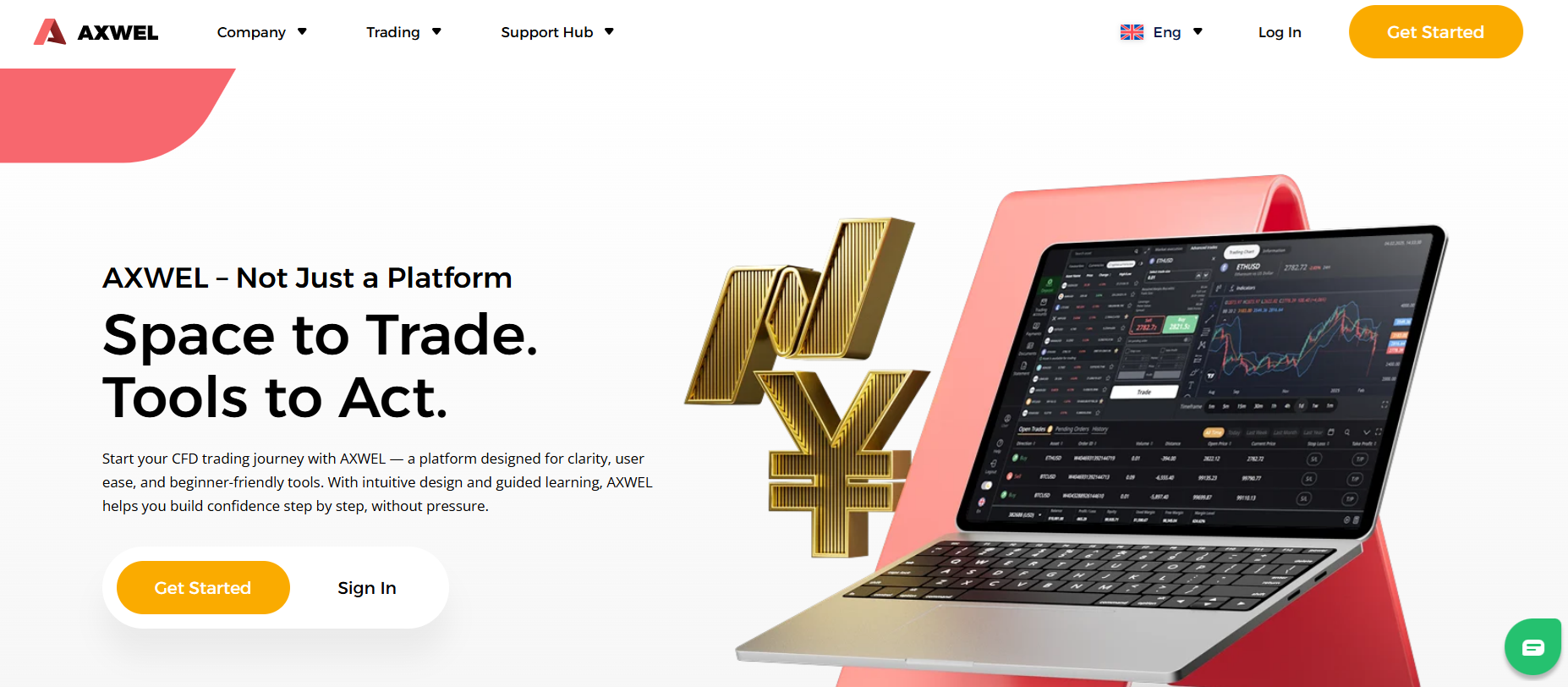
Axwel positions itself as a modern CFD trading platform, aimed at both beginners and more experienced market participants. The company emphasizes ease of use, access to trading instruments, and educational support, promising clients a comfortable start and a clear environment for working in the financial markets.
We want to understand who is behind the platform, how it is regulated, how transparent its trading conditions are, and what guarantees clients receive.
In this review, we will examine Axwel in detail, verify its legal information, and analyze its trading conditions, platform operation, and financial transactions. This will help us determine how the company’s promises match reality and whether it can be considered a reliable broker.
Who Regulates Axwel and Can Its License Be Trusted?
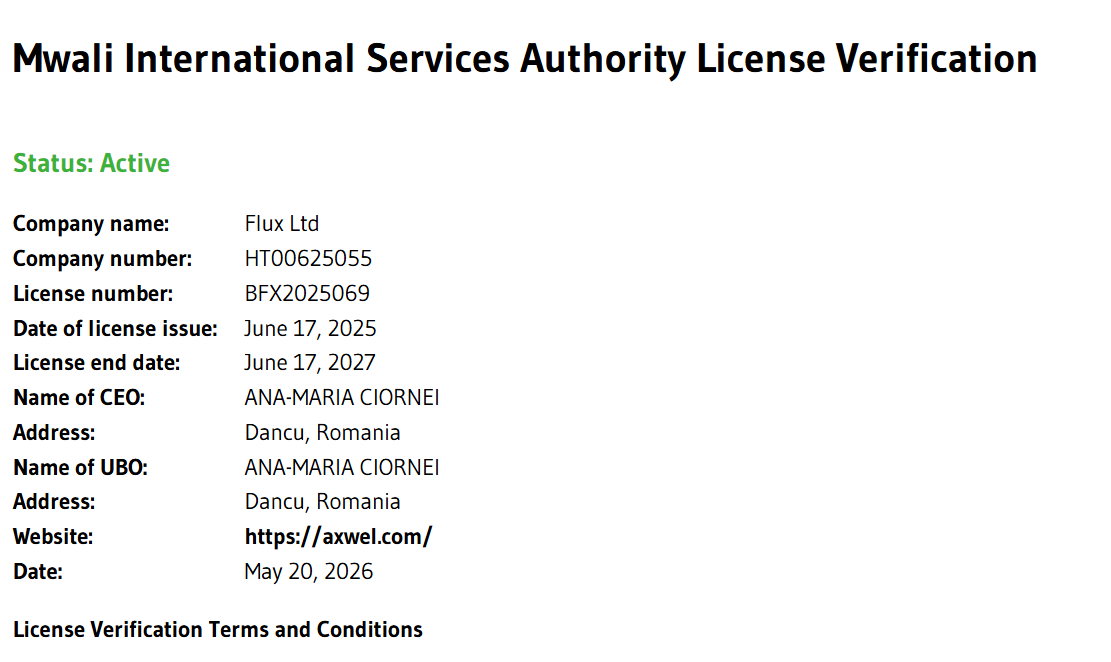
According to information published on the Axwel website, the platform is operated by Flux Ltd, a company registered in the Comoros Islands. As proof of its legality, the broker cites MISA (Mwali International Services Authority) license No. BFX2025069.
We have verified this information and can confirm that this is indeed an offshore license issued by the Mwali Island regulator. However, it is important for potential clients to understand that MISA is not a reputable international financial regulatory body.
Unlike regulators such as the FCA in the UK, CySEC in Cyprus, ASIC in Australia, or BaFin in Germany, MISA imposes significantly less stringent requirements on licensed companies. Obtaining such a license requires relatively little expense and does not imply the level of oversight typical of major financial jurisdictions. Furthermore, companies operating under a MISA license do not participate in investor compensation funds, are not required to adhere to strict capital requirements, and are not subject to regular audits to the extent considered standard by leading global regulators.
For this reason, a MISA license should be viewed more as a formal permit to operate than as a serious guarantee of the reliability and security of client funds.
Axwel Account Types and Assets
According to its website, Axwel offers access to CFD trading on various asset classes. The list of instruments includes currency pairs, commodities, indices, stocks, and other popular markets traditionally offered by online brokers.
The company focuses not on the variety of instruments, but on its account system. Clients are offered three account types: Silver, Gold, and Platinum. As the account level increases, the broker promises more favorable trading conditions, including discounts on spreads and swaps.
💡 Note: The basic Silver account is aimed at beginning traders and offers standard trading conditions. Gold holders receive a spread discount of up to 50% off the basic level and reduced swaps, while the Platinum account offers even more significant benefits. However, the company does not disclose the initial spread sizes, making it difficult to assess the true benefit of these discounts.
Trading Conditions: Spreads, Commissions, and Leverage
Compared to many offshore brokers, Axwel publishes somewhat more trading information. For example, the company lists maximum leverage of up to 1:200, minimum trade sizes from 0.01 lots, and a stop-out level of 5%.
Furthermore, specifications for several currency pairs are available on the website, including contract sizes, trading hours, and some swap parameters. This allows for at least a general overview of the instruments offered.
However, the terms and conditions are far from completely transparent. The broker does not disclose actual spreads for Silver, Gold, and Platinum accounts, does not publish average values for key instruments, and does not provide information about possible additional commissions. Instead of specific figures, clients are offered percentage discounts from an unknown base value.
As a result, potential traders only receive a partial understanding of trading costs. Despite the availability of individual instrument specifications, many parameters that directly impact client costs remain insufficiently disclosed.
How Does Axwel Handle Trade Execution?
The quality of order execution directly impacts trading results, so reputable brokers typically disclose detailed information about their execution model, liquidity providers, and client order processing mechanisms. In the case of Axwel, a specific execution policy is indeed published.
According to the company’s documentation, all trades are executed through the trading platform using the client’s credentials. The broker reserves the right to consider any transaction executed through the user’s account as fully authorized and is not required to request additional confirmation.
Axwel also warns clients in advance of the possibility of slippage. The company explicitly states that the actual execution price may differ from the quote displayed at the time the order was submitted. Furthermore, the broker reserves the right to execute trades at the best available price at the time the order is processed, which may be better or worse than the client’s expectations.
Particular attention should be paid to provisions regarding technical failures. In the event of quoting errors, price freezes, sharp fluctuations, or other problems, the company may not only refuse to execute the order but also change the price of an existing transaction or completely cancel the previously executed transaction. Axwel does not disclose information about its liquidity providers, order execution model, or client trade routing. The website lacks data on average execution speed, slippage statistics, and other metrics typically published by more transparent brokers.
Axwel Withdrawals and Deposits: What Should Clients Expect?
Financial transactions are a crucial aspect of any broker’s operations, so transparency regarding account deposit and withdrawal policies is crucial for potential clients. Axwel publishes separate policies regarding payment transactions.
💡 Note: According to the company’s documentation, withdrawal requests are accepted and processed on business days. Requests submitted before the deadline may be processed the same day, while later requests are postponed until the next business day. After withdrawal approval, clients are advised to wait five to seven days for funds to arrive, as further processing depends on banks and payment providers.
The company also emphasizes that before withdrawing funds, clients may be required to undergo additional verification and provide documents required by internal security procedures and AML requirements. Withdrawals may be suspended until verification is complete.
Axwel does not disclose information about segregated accounts, client fund insurance, or participation in any investor compensation programs. As a result, Axwel’s financial transaction policies appear more detailed than those of some similar offshore brokers, but the level of transparency remains limited.
Revexium publishes more information about its financial transactions than many typical offshore brokers, but its level of transparency is still far from ideal.
Axwel Trading Platform: Features and Limitations
The trading platform is one of the most important components of any brokerage service. It is through it that clients access markets, analyze charts, and execute trades. Axwel uses a web terminal built on TradingView solutions.
Users have access to modern charts, a wide range of technical analysis tools, and a familiar interface familiar to many traders. The platform is accessed directly through a browser, without the need to install additional software.
Unlike many dubious brokers, Axwel offers a demo account. This allows potential clients to test the platform’s functionality and familiarize themselves with the trading environment without depositing real funds.
At the same time, the company’s mobile infrastructure appears rather limited. We were unable to find fully functional iOS and Android apps or links to official pages on the App Store and Google Play. Mobile trading is most likely conducted through a browser-based version of the platform, adapted for smartphones and tablets.
Overall, Axwel’s trading infrastructure appears somewhat better than that of many similar offshore brokers. The use of TradingView technologies and the availability of a demo account can be considered as advantages of the company.
Account Verification Process at Axwel
Like most online brokers, Axwel requires clients to complete identity verification as part of its KYC and AML requirements.
To verify an account, users must provide an identity document, such as a passport or national ID card, as well as proof of address. This can include a bank statement, utility bill, or other official document showing the address.
In some cases, the company may also request confirmation of the payment method used to fund the account. This is a standard practice aimed at preventing fraud and unauthorized financial transactions.
Overall, Axwel’s verification process appears quite standard and is virtually identical to the requirements of most brokers and financial platforms.
Comparing Axwel with Other Trading Platforms
Compared to large regulated brokers, Axwel presents a rather mixed picture. On the one hand, the company provides more information about trading instruments and conditions than many typical offshore platforms. On the other hand, the level of regulation and client protection is significantly lower than that of leading financial jurisdictions.
Licensed brokers, supervised by reputable regulators, offer a higher level of protection for client funds, participate in compensation programs, and undergo regular monitoring by regulatory authorities. In the case of Axwel, the company relies on a MISA license, which provides significantly less stringent oversight.
At the same time, Axwel does have some advantages over many similar offshore brokers. The company uses a TradingView-based platform, offers a demo account, and publishes some trading specifications, including leverage, contract parameters, and specific details on trading instruments.
However, many important aspects remain insufficiently transparent. The broker doesn’t disclose its liquidity providers, doesn’t publish order execution statistics, doesn’t provide detailed information on commissions, and reserves broad discretion over the processing of trading operations and financial transactions.
As a result, Axwel appears somewhat more open than many typical offshore brokers. However, in terms of transparency, regulation, and client protection, it still significantly lags behind large international companies operating under the supervision of leading financial regulators.
Axwel Review: Final Verdict
Axwel appears more transparent than many offshore brokers, publishing its licensing information, offering a demo account, and disclosing some of its trading conditions. However, the company operates under a MISA license, which does not provide the same level of oversight and investor protection as leading global regulators. Despite its TradingView-based platform and access to various markets, many important aspects of the broker’s operations remain insufficiently disclosed. Clients still lack full information about fund protection, order execution, and certain trading costs. For this reason, potential investors should approach Axwel with caution and carefully assess the potential risks.
Risk Warning!
Trading CFDs, forex, cryptocurrencies, commodities, and other leveraged instruments involves a substantial level of risk and may lead to partial or complete loss of invested funds. Due to the use of leverage, even small market movements can have a significant impact on trading results, increasing both potential profits and potential losses.
Before opening an account with any broker, investors should carefully evaluate their financial situation, trading experience, and ability to absorb potential losses. Financial markets are inherently unpredictable, and no platform can guarantee consistent profits or protection from risk.
The information contained in this review is provided solely for informational purposes. It does not constitute investment advice, financial recommendations, or an endorsement of any broker, trading platform, or financial product.



Leave a Reply